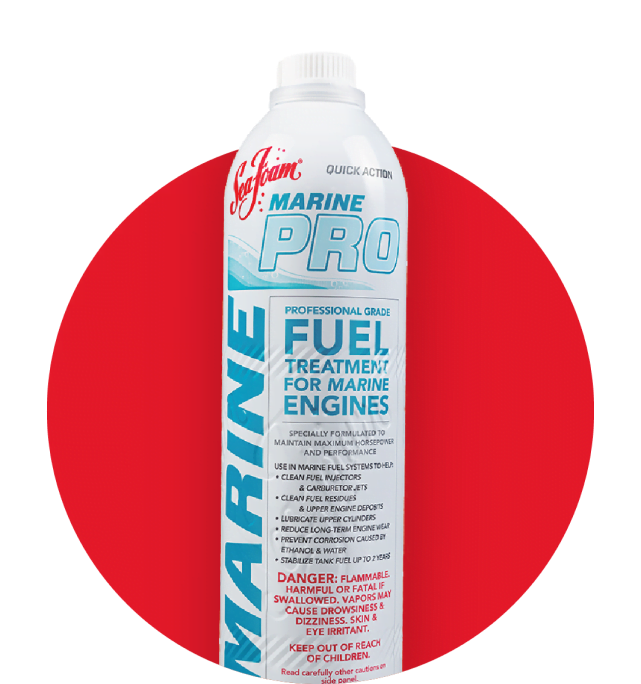
HOW TO USE MARINE PRO FUEL TREATMENT
IN BOAT ENGINE FUEL
BENEFITS
DIRECTIONS
treatment recommendations
SUMMARY
Add Marine PRO to every tank of fuel to help your marine engine start faster, run smoother, and last longer. It works through fuel injectors and carburetors to safely remove harmful engine residues and deposits from fuel passageways, intake valves, pistons and chamber areas.
Marine PRO is safe and effective in all 2- and 4-stroke gasoline marine engines, inboard and outboard. Marine PRO only contains petroleum-based cleaning and lubricating ingredients. It does NOT contain harsh chemicals or abrasive detergents that could harm your engine. Marine PRO does not contain alcohol.

HOW TO USE SEA FOAM
marine pro
RELATED QUESTIONS
My boat sat for a year and a half and has a half tank of old gas. It has a 2 cycle outboard motor. Would it be a good idea to add a whole can of Sea Foam and top off the tank with fresh gas, and run the engine for 20 minutes or so to clean out the old gas in the engine?
Good question, Dave. The best practice would be to drain the old fuel and start fresh with 2 gallons of fresh non-oxy gas and a whole 20 oz can of Marine PRO.
If the fuel is only a year and a half old, though, it should still start and run fine. The goal would be to create a high cleaning concentration of Sea Foam to fuel so it can clean up any fuel gum or varnish that formed while the boat was sitting.
What I’d do: Add a full 20 oz can of Sea Foam Marine PRO to your half tank of fuel. Run it for 20 minutes to burn through the treated fuel. Then, top it off with fresh fuel. You can add another can of Marine PRO if you want to the fresh fuel. It’ll continue to clean as you use up the tank, as well as prevent fuel gum and varnish from forming.
I have a 2004 Yamaha 60 HP outboard. It idles fine and runs fine at full throttle. But it sputters a bit when I’m powering it up through mid throttle. Will Sea Foam take care of that mid throttle sputtering?
Good question, Wayne. If the sputtering is caused by fuel gum/varnish, Sea Foam will help clean it up and help overcome the sputtering.
Here’s what I’d do: Wait until you have a low tank of fuel (1-2 gallons). Then, add a full can of Marine PRO to the fuel. Run your boat at least 20 minutes if you can (just don’t run out of gas!), and don’t be afraid to run it hard. After that, refill your fuel tank as normal.
Here’s a (rather lengthy) explanation of why a high concentration works best. For upper engine cleaning (fuel injectors/carburetor circuits & chamber deposits that can affect running performance), it works much better to add the full can to a low amount of fuel for two reasons, 1) the cleaning concentration is considerably greater and, 2) the cleaning effect will start much faster with greater effectiveness. If you were to add Marine PRO to a high volume of tank fuel, it might take several hours of engine running for a lower concentration of the treatment to work its way through the fuel lines and through the engine. Understanding the concentration approach will go a long way in terms of understanding how Sea Foam’s engine products work for overcoming fuel residue restrictions or a rough-running engine. Pay attention to starting, smooth idle, throttle response, hole shot, acceleration, and top speed. The #1 cause of each of these issues is heavier suspended fuel gum and petroleum varnish that restricts fuel passageways. The most important thing Marine PRO does is liquefy and clear away sticky gum and varnish restrictions so the engine can go back to starting fast and running strong.
Hope that helps!
How much Sea Foam do I put in a 3 gallon tank for an outboard motor?
Can I put Sea foam in my 2-stroke outboard Yamaha 150hp external oil reservoir to clean the oil system? And if yes, which Sea Foam product would be best?
Is it ok to add Sea Foam to a marine engine?
Hi Tim,
Thanks for the question! You can use Sea Foam Motor Treatment in a marine engine. (High Mileage Motor Treatment is also effective in a marine engine).
That said, I’d also consider using Marine PRO. It’s a great cleaner made specifically for marine engines.
Either one is a good option!

Jim D.TECH
0